ADA Sidewalks & Curbs in New Orleans, LA
ADA sidewalk and curb work means forming, pouring, and finishing concrete ramps, curb cuts, and accessible routes so that every transition point meets the dimensional requirements in the ADA Standards for Accessible Design. For property managers, general contractors, and business owners in New Orleans and the surrounding parishes, that includes controlling slope, installing detectable warning surfaces, and managing subgrade conditions that local soils make difficult. The work is measurable, inspectable, and either compliant or not.
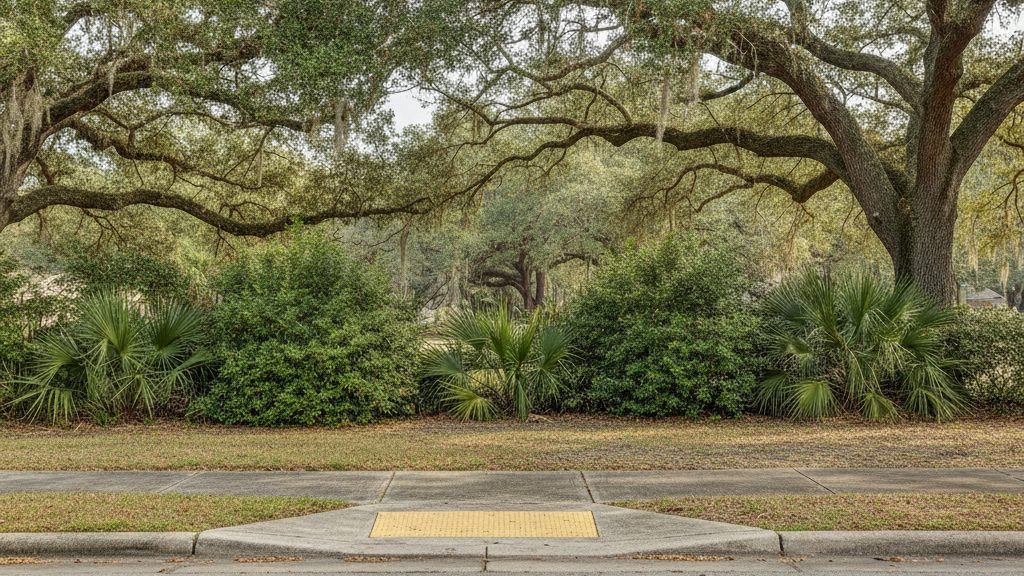
Key facts
- Curb ramps require a maximum 1:12 slope and a 36-inch minimum clear width under ADA standards.
- Detectable warning surfaces use truncated domes set on a 2.35-inch center-to-center grid, colored to contrast with the surrounding concrete.
- Cross slope on an accessible route measures 2 percent or less, verified with a digital level on every panel.
- A typical 200 to 400 square foot curb cut and ramp replacement in New Orleans runs $4,800 to $11,000 in 2026 pricing.
- Concrete reaches adequate strength for foot traffic in 24 to 48 hours and full design strength at 28 days.
What ADA Sidewalks and Curbs Work Covers in New Orleans
ADA sidewalk and curb work covers the full range of accessible route construction: curb cuts, curb ramps, detectable warning surfaces, sidewalk panel replacement, and transition sections between grade changes. A compliant curb ramp requires a running slope no steeper than 1:12, a cross slope at or below 2 percent, and a 36-inch minimum clear width. Detectable warning surfaces are cast-in or surface-applied truncated dome panels installed at the base of every curb ramp and at hazardous vehicular crossings. ADA sidewalk work does not include striping, signage, or accessible parking layout; those are separate scopes.
A typical job begins with a site assessment using a digital level to document existing slopes and identify non-compliant panels. Demolition follows, removing the non-compliant concrete back to a clean break. Subgrade preparation, forming, reinforcement, and the pour complete the sequence. The last step before opening the area is verifying finished slope measurements at each panel.
What Does ADA Curb and Sidewalk Work Cost in New Orleans?
A single curb cut and ramp replacement in New Orleans runs $4,800 to $11,000 in 2026, depending on size, existing subgrade condition, detectable warning surface type, and whether saw-cutting and demolition of a thick existing slab is required. Larger accessible route repairs covering 400 to 1,200 square feet of sidewalk panel replacement run $18,000 to $52,000. Four variables move the number most: linear feet of curb to saw-cut and remove, the depth of subgrade repair needed after the soft fill is exposed, whether cast-in detectable warning panels or surface-applied retrofit units are specified, and the finish requirement (broom versus exposed aggregate).
Permit requirements vary by parish. Confirm applicable thresholds and fees with the relevant parish permit office before bidding or scheduling.
How Is ADA Sidewalk and Curb Work Done, Step by Step?
ADA sidewalk and curb construction follows a fixed sequence; shortcutting any step produces a slab that will fail slope compliance or settle out of tolerance within a few years.
Assessment and layout
A digital level records existing cross slope and running slope at every panel. Non-compliant areas are marked and the scope is fixed before demolition begins. Ramp geometry is laid out so the 1:12 running slope and landing dimensions are achievable given the fixed curb height.
Demolition and excavation
Existing concrete is saw-cut at clean joints, broken out, and removed. Excavation goes to a minimum of 10 inches below finished grade to allow for 4 inches of compacted base and a 6-inch slab where local conditions require the added thickness.
Subgrade preparation and compaction
Base material is placed in 3-inch lifts and compacted to 95 percent standard Proctor density. A 6-mil polyethylene vapor barrier is laid over the prepared base before reinforcement is set.
Forming and reinforcement
Forms are set to produce the specified slope. Ramps get a minimum of 3,500 PSI concrete with No. 3 rebar on 18-inch centers. Detectable warning panel frames are positioned and secured in the form before the pour.
Pour, finish, and joints
Concrete is placed, struck off to the form, and finished with a medium broom perpendicular to the direction of travel. Control joints are cut to one-quarter of the slab thickness, at a maximum of 5-foot intervals on ramp panels, within 12 hours of the pour.
What Do New Orleans Ground Conditions Change About This Work?
Greater New Orleans sits on soft alluvial clay and organic silt over a high water table. That soil consolidates under load, which is why concrete panels across the city have settled 1 to 3 inches out of plane over 10 to 20 years. For ADA work, settlement is a direct compliance failure because a panel that shifts even half an inch can push the cross slope past the 2 percent limit.
Subgrade preparation for ADA concrete in New Orleans requires more material and more compaction effort than comparable work on the north shore or in river parishes with firmer native soils. Lime stabilization of the top 6 inches of native clay is added on soft sites before the aggregate base is placed. Slab thickness increases from a standard 4 inches to 6 inches on ramps where vehicular overrun is possible. Drainage fall of at least 1 percent away from structures is designed into every panel to prevent ponding that accelerates slab movement in saturated clay.
How Long Does ADA Sidewalk Work Take and When Can the Area Be Used?
A single curb cut and ramp replacement takes 2 to 3 working days from demolition through final slope verification. A multi-panel sidewalk repair covering 600 to 800 square feet runs 4 to 6 working days depending on subgrade conditions. Foot traffic is permitted 24 to 48 hours after the pour. The area remains closed to vehicle traffic for 7 days. Concrete reaches full design strength at 28 days; do not apply sealers or surface coatings before that point.
How Do You Tell Good ADA Concrete Work from Bad?
Good ADA concrete work is verifiable with simple tools. A property manager or GC can check the following on any finished ramp or curb cut.
- Running slope: a digital level held parallel to travel direction reads 8.3 percent or less (1:12) at any point on the ramp.
- Cross slope: the same level held perpendicular to travel reads 2 percent or less across the full width of the panel.
- Detectable warning surface: truncated domes are present at the base of every curb ramp, domes are intact with no voids or pop-outs, and the surface color contrasts visually with the surrounding concrete.
- Joint depth: control joints are cut to at least one-quarter of the slab depth. On a 4-inch slab, that is a minimum 1-inch cut. Shallow joints allow random cracking.
- Edge quality: slab edges are free of honeycombing. Visible aggregate with voids larger than 3/8 inch at the form line indicates poor consolidation.
- Drainage: water does not pond on any panel after rain. Standing water after 30 minutes indicates a flat or back-sloped panel that will accelerate settlement.
New Orleans Concrete Contractors provides free on-site estimates for ADA sidewalk and curb projects across Greater New Orleans and the surrounding parishes. Bring the site assessment, the scope, and your questions; a written range price follows the same visit.
Common questions
- What slope is required for an ADA curb ramp in New Orleans?
- An ADA curb ramp requires a maximum running slope of 1:12, which equals 8.33 percent grade, and a cross slope of 2 percent or less across the full width of the ramp. Both measurements are verified with a digital level at multiple points on the finished surface before the area is reopened.
- What are truncated domes and where do they go?
- Truncated domes are the raised dot pattern on a detectable warning surface. They are placed at the base of every curb ramp and at transitions where a pedestrian path meets a vehicular route. Dome centers are spaced 2.35 inches apart. The surface color must contrast with the surrounding concrete to be visually detectable.
- How much does a curb cut replacement cost in New Orleans?
- A single curb cut and ramp replacement in New Orleans runs $4,800 to $11,000 in 2026, depending on the size of the ramp, depth of subgrade repair, detectable warning surface type, and demolition complexity. Multi-panel sidewalk repairs covering 400 to 1,200 square feet run $18,000 to $52,000.
- Do I need a permit for ADA sidewalk work in New Orleans?
- Permit requirements vary by parish and project scope. Confirm applicable thresholds, fees, and submittal requirements with the relevant parish permit office before scheduling work. ADA compliance standards are set federally, but permit authority sits with the local jurisdiction.
- Why do concrete ramps in New Orleans settle so quickly?
- New Orleans sits on soft alluvial clay and organic silt over a high water table. The native soil consolidates under load, causing slabs to settle 1 to 3 inches over 10 to 20 years. Proper subgrade preparation, including lime stabilization and compacted aggregate base placed in 3-inch lifts, reduces but does not eliminate long-term movement on this soil.
- When can foot traffic use a new ADA ramp after the pour?
- Foot traffic is safe on new ADA concrete 24 to 48 hours after the pour. The area stays closed to vehicle traffic for 7 days. Concrete reaches full 3,500 PSI design strength at 28 days, and no sealers or surface coatings should be applied before that point.
ADA Sidewalks & Curbs by area
Metairie
Jefferson Parish
Kenner
Jefferson Parish
Gretna
Jefferson Parish
Harvey
Jefferson Parish
Marrero
Jefferson Parish
Westwego
Jefferson Parish
Harahan
Jefferson Parish
River Ridge
Jefferson Parish
Terrytown
Jefferson Parish
Chalmette
St. Bernard Parish
Arabi
St. Bernard Parish
Slidell
St. Tammany Parish
Mandeville
St. Tammany Parish
Covington
St. Tammany Parish
Destrehan
St. Charles Parish
Luling
St. Charles Parish
Belle Chasse
Plaquemines Parish
Last updated August 6, 2026
Get a free estimate
Tell us what you need and where. An estimator walks the site, measures, and leaves you a written number. The visit takes 20 to 30 minutes and costs nothing.
- Free on-site measurement and written estimate
- Serving New Orleans and surrounding parishes within 40 miles
- Residential and commercial work